
Systems That Turn Complexity Into Growth
Most companies don’t struggle with demand.
They struggle with structure.
Fragmented tools, scattered communication, and manual reporting create hidden bottlenecks that slow growth.
PB Systems designs the operational systems that connect leads, operations, and reporting into one clear view.
Here are real examples of what that looks like in practice.
The Real Problem
You’re not short on tools: you’re drowning in them.
Your team spends more time updating systems than closing deals.
Data is messy. Leads fall through the cracks. Decisions are made on gut, not facts.
You don’t have a tech problem - you have a systems problem.
If you’re juggling CRMs, spreadsheets, and manual reports - you already feel the cost. It’s not just time; it’s opportunity lost.
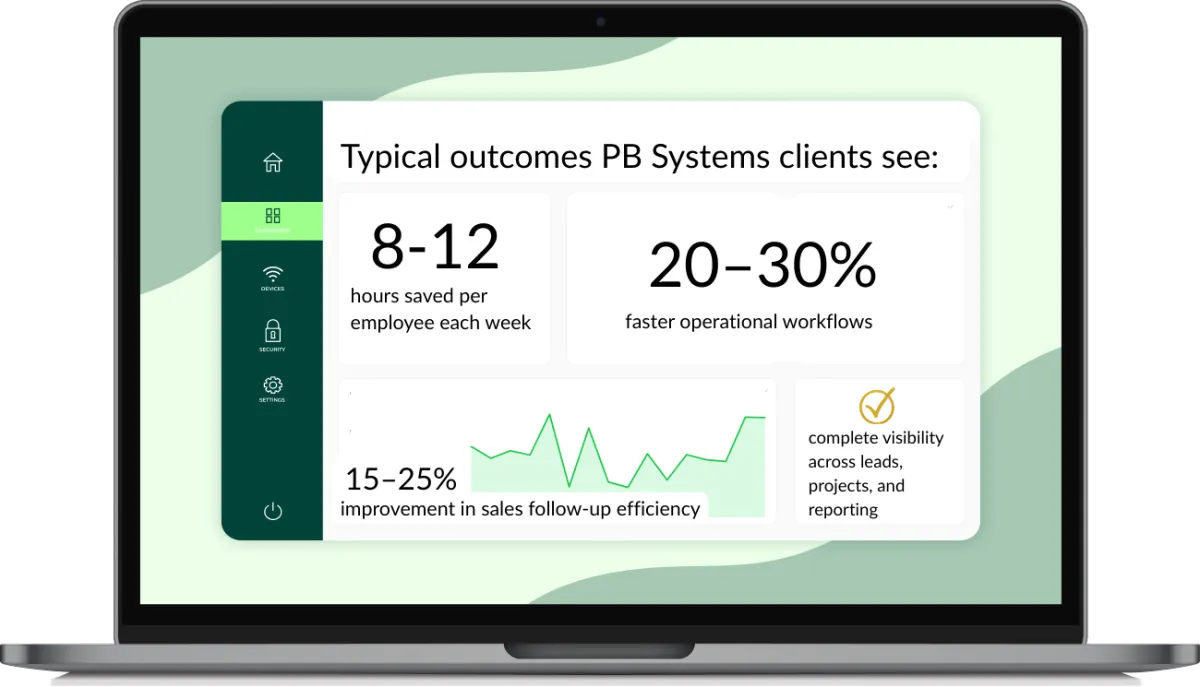
Average PB Systems client saves 8–12 hours per employee weekly.
Case Study
How a Growing Accounting Firm Increased Revenue by ~30% After Replacing Fragmented Manual Processes.
Client: Dexto Group – Poland
Multi-service accounting practice providing bookkeeping, tax advisory, and payroll services for SMEs

Situation Before PB Systems
As the firm grew, its internal processes became increasingly fragmented.
Client data, billing information, and service tracking were spread across:
- multiple spreadsheets
- internal accounting software
- manual verification processes
- email communication between departments
This created three critical operational problems.
The System Implemented
PB Systems designed and implemented a centralized operational system connecting the firm’s key workflows.
The implementation included:
• Unified client and billing data structure
• Automated invoice preparation logic
• Centralized reporting dashboards for leadership
• Clear tracking of services and billing tiers
This removed the need for fragmented spreadsheets and manual reconciliation.
Unlike plug-and-play tools, every PB System is architected around your specific workflows, KPIs, and growth goals.
Limited visibility for leadership
The owner could not easily see:
-client profitability
- real monthly revenue
- billing inconsistencies
Financial insights required manual data consolidation.
Revenue leakage from manual verification
Invoices were prepared through manual cross-checking of:
- service packages
- payroll services
- document volume tiers
This created delays and increased the risk of missed billable services.
Operational scaling friction
As the number of clients increased, so did the time required for:
- billing validation
- data reconciliation
- internal reporting
Growth meant more manual work, not more efficiency.
Measurable Outcomes
⇨ Within 12 months, the firm experienced measurable operational and financial improvements.
~30% revenue growth
Revenue increased significantly after improving billing visibility and eliminating missed billable services.
⇨ Manual billing verification reduced dramatically
Invoice preparation moved from manual cross-checking to a structured automated workflow.
This reduced administrative workload across the team.
⇨ New hires to support growth
With clearer financial visibility and improved operational efficiency, the firm expanded its team to support increasing demand.
⇨ Leadership gained real-time visibility
The owner could now monitor:
• monthly revenue
• client profitability
• service usage patterns
—all from a single dashboard.
Key Insight
The biggest transformation was not marketing or lead generation.
It was operational clarity.
Once fragmented processes were replaced with a structured system, the firm gained:
- clear financial visibility
- reliable billing processes
- scalable internal operations
This allowed leadership to focus on growth instead of manual oversight..
Core Result
- ~30% revenue growth within 12 months
- Reduced manual administration
- Improved financial visibility for leadership.

Let's Built Your Intelligent System.

Case Study
How a Media Brand Increased Monetization Efficiency by 300%+ While Reducing Operational Complexity
Situation Before PB Systems
As the brand grew, monetization and community management became increasingly fragmented.
Revenue channels existed across multiple platforms:
• Patreon
• YouTube memberships
• Sponsorships
• Ad revenue
However, these systems did not communicate with each other.
Three operational problems emerged.
Fragmented Infrastructure
Different tools handled:
• payments
• community access
• premium content
• communication
This created data fragmentation and operational friction.
Scaling the audience required more manual coordination, not less.
Less confusion. Faster action.
Systems built to keep pace as your business grows.
Growth Increased Workload
As the community expanded, the operational workload grew faster than revenue.
Each new member required:
• manual management
• content access adjustments
• communication coordination
Growth became operationally expensive.
Limited Monetization Visibility
Because revenue channels were spread across multiple systems, leadership had no unified visibility into community monetization performance.
Key questions became difficult to answer:
• Which members generated the most value?
• Which tiers converted best?
• Where did engagement drop off?
Your success,
The System Implemented
#1
Centralized Communication
PB Systems designed a unified membership and monetization infrastructure.
The system integrated:
• subscription management
• member access
• content delivery
• communication tools
• payment infrastructure
All within one centralized operational platform.
#2
Real-Time Visibility
Track clients, projects, and pipelines instantly: spot opportunities before they slip away.
#3
Continuous Optimization
Ongoing support and evolving automations that grow with your business.
Measurable Outcomes
After implementing the new system architecture, the brand experienced several measurable improvements.
300%+ increase in monetization efficiency
The unified system allowed the creator to monetize the audience far more effectively without increasing operational workload.
Operational complexity reduced significantly
Previously fragmented platforms were replaced by one structured system.
This eliminated manual coordination between tools.
Scalable revenue infrastructure
New members could now join and engage without increasing management workload.
The system supports continuous audience growth without operational friction.
Stronger direct audience relationships
Instead of relying purely on platform algorithms and advertising, the brand built direct recurring relationships with its audience.
This created a more predictable monetization model.
Key Insight
The transformation did not come from more audience growth.
It came from system architecture.
Once fragmented tools were replaced with a unified infrastructure, the brand could:
• monetize the same audience more effectively
• reduce operational workload
• scale without additional complexity
If you’re juggling CRMs, spreadsheets, and manual reports - you already feel the cost. It’s not just time; it’s opportunity lost.
Strategic Takeaway
Many businesses believe they need more leads or more audience to grow.
But often the real constraint is system fragmentation.
When operations, communication, and revenue channels run through a unified system, companies unlock growth that was previously limited by operational complexity.
Result Summary
- 300%+ improvement in monetization efficiency
- Reduced operational workload
- Unified infrastructure replacing fragmented platforms
our Partners





What These Companies Had in Common
Despite operating in different industries, the underlying problem was the same.
As these businesses grew, their systems became fragmented.
Client data, communication, reporting, and workflows were spread across spreadsheets, inboxes, and disconnected tools.
This created three common issues:
• Limited visibility into revenue and operations
• Manual processes slowing down teams
• Opportunities lost due to inconsistent follow-ups and tracking
What Changed?
PB Systems replaced fragmented tools with one connected operational system.
The result:
- More visibility.
- Less manual work.
- More predictable growth.
Contact Us
Let's Design a System That Works - For Your Business
Tell us a bit about your business, and we’ll prepare a personalized roadmap - including time, tools, and next steps: to build your system the smart way.
Intelligent systems.
Clear decisions.
Less chaos.
Built to help your team save time and grow predictably.
About
Solutions / Pillars
Smarter Operations
Smarter Decisions
Revenue Growth Systems
Unified Platform
Resources
Strategy Consultation
Testimonials
Ready to see how your systems can work for you?
© 2026 PB Systemy - All Rights Reserved.